
Operations on Integers Worksheet PDF: A Comprehensive Plan
This resource delivers focused practice on integer operations, encompassing addition, subtraction, multiplication, and division,
specifically designed for 6th-grade mathematics students via printable PDF worksheets.
Delving into the world of integers is a fundamental step in mastering mathematical concepts, and these worksheets provide a solid foundation. Integers extend beyond positive whole numbers to include zero and negative numbers – representing quantities both above and below zero. Understanding integers is crucial for real-world applications, from tracking temperature changes to managing finances.
These worksheets aren’t just about rote memorization; they aim to build conceptual understanding. Students will encounter problems designed to solidify their grasp of what integers are and how they differ from other number sets. The progression begins with identifying integers, then moves towards understanding their placement on a number line, preparing them for the operations to follow. This initial phase is vital for success with more complex integer calculations;
What are Integers?
Integers encompass the set of whole numbers and their negatives, including zero. This means positive numbers like 1, 2, 3, and so on, negative counterparts like -1, -2, -3, and crucially, zero itself. Unlike fractions or decimals, integers are always whole numbers – no parts in between. These worksheets focus on building fluency with this specific number system.

Understanding the concept of ‘opposite’ is key to grasping integers. Every positive integer has a corresponding negative integer, equidistant from zero. The worksheets reinforce this idea through visual representations and practice problems. Students will learn to identify integers in various contexts and differentiate them from other types of numbers. This foundational knowledge is essential before tackling operations like addition and subtraction.
Positive and Negative Integers

Positive integers are greater than zero, representing quantities above a starting point or gain. Think of earning money – each dollar earned is a positive integer. Conversely, negative integers are less than zero, indicating quantities below a starting point or loss. Spending money represents negative integers. These worksheets utilize real-world scenarios to illustrate this distinction.
The number zero serves as the neutral point, neither positive nor negative. Understanding this duality is crucial for performing operations with integers. The PDF worksheets provide ample practice identifying and interpreting both positive and negative integers in various contexts, like temperature scales (above/below zero) or debt/credit. Mastering this concept is a prerequisite for successfully navigating integer addition, subtraction, multiplication, and division exercises.
Integer Operations: An Overview
Integer operations encompass the fundamental mathematical processes – addition, subtraction, multiplication, and division – applied to both positive and negative whole numbers. These worksheets systematically guide students through each operation, building a solid foundation for more advanced algebraic concepts. The core focus is on understanding the rules governing these operations when dealing with positive and negative values.
For instance, adding a negative integer is equivalent to subtraction, a concept frequently reinforced within the practice problems. Similarly, multiplying or dividing integers introduces the rule of signs (positive x positive = positive, negative x negative = positive, etc.). The PDF format allows for focused practice, with short answer questions designed to assess comprehension and procedural fluency. These worksheets aim to transform abstract rules into concrete skills.
Addition of Integers
Adding integers involves combining quantities, and these worksheets provide targeted practice in mastering this fundamental skill. Students encounter problems requiring them to add both positive and negative integers, reinforcing the concept of direction and magnitude. A key element is understanding that adding a negative integer is the same as subtracting a positive one – a crucial rule emphasized throughout the exercises.
The worksheets present a variety of addition problems, progressing from simple combinations to more complex scenarios. Emphasis is placed on visualizing integer addition using number lines, aiding comprehension. The short answer format encourages students to demonstrate their understanding of the rules and apply them accurately. These exercises build a strong foundation for future mathematical operations.
Rules for Adding Integers
Mastering integer addition hinges on understanding key rules, which these worksheets systematically reinforce. When adding integers with the same sign (both positive or both negative), students are guided to add the absolute values and retain the common sign. For instance, -3 + (-5) equals -8. Conversely, adding integers with different signs requires finding the difference between their absolute values and adopting the sign of the integer with the larger absolute value.
The worksheets present numerous examples illustrating these rules, prompting students to apply them consistently. Visual aids, like number lines, are often incorporated to solidify understanding. Through repeated practice with short answer questions, students internalize these rules, enabling them to confidently tackle increasingly complex addition problems.
Adding Integers with the Same Sign
Worksheets dedicated to same-sign integer addition build fluency through focused repetition. The core principle is straightforward: when combining integers sharing the same sign – both positive or both negative – learners add their absolute values. The resulting sum inherits the original shared sign. For example, 5 + 3 yields 8, while -2 + (-7) results in -9.
These practice sheets present a variety of problems, starting with simpler combinations and gradually increasing in complexity. Students are encouraged to visualize this process, perhaps using counters or number lines initially. The emphasis is on procedural understanding and accuracy. Consistent practice solidifies this rule, forming a foundational skill for more advanced integer operations, preparing them for mixed-sign additions.
Adding Integers with Different Signs
Worksheets focusing on adding integers with differing signs present a slightly more complex challenge. The key concept revolves around finding the difference between the absolute values of the integers. Once the difference is determined, the sign of the result is dictated by the integer possessing the larger absolute value. For instance, -8 + 5 yields -3, as 8 is larger than 5, and the negative sign prevails.
These practice materials often include problems designed to reinforce this rule, progressing from simpler examples to those requiring careful attention to detail. Visual aids, like number lines, can be particularly helpful in illustrating this process. Mastering this skill is crucial, as it bridges the gap towards understanding subtraction as adding the opposite, and builds a solid foundation for algebraic manipulation.
Subtraction of Integers
Worksheets dedicated to integer subtraction emphasize a critical transformation: reframing subtraction as the addition of the opposite. This concept is foundational for success with more complex algebraic operations. Instead of 5 ⎻ 3, students learn to visualize and solve 5 + (-3). This shift simplifies the process, allowing them to apply the rules for adding integers they’ve already mastered.
Practice problems progressively increase in difficulty, incorporating both positive and negative integers. Many worksheets utilize number lines to visually demonstrate the concept of moving in the opposite direction. Understanding this conversion is paramount, as it eliminates confusion and provides a consistent approach to solving subtraction problems involving integers, ultimately building confidence and fluency.
Subtraction as Adding the Opposite
A core principle within integer subtraction, worksheets consistently reinforce the idea that subtracting an integer is equivalent to adding its additive inverse. For example, 7 ― 2 becomes 7 + (-2). This isn’t merely a trick; it’s a fundamental shift in understanding that unifies addition and subtraction under a single set of rules. This approach eliminates the need to learn separate subtraction rules, streamlining the learning process.
Worksheet exercises specifically focus on this conversion, prompting students to rewrite subtraction problems as addition problems before solving. Visual aids, like number lines, often accompany these exercises to demonstrate the concept. Mastery of this skill is crucial, as it forms the basis for more advanced algebraic manipulations and problem-solving strategies involving negative numbers.
Rules for Subtracting Integers
Worksheets dedicated to integer subtraction emphasize a concise set of rules, building upon the concept of “adding the opposite.” The primary rule dictates that subtracting any number is the same as adding its negative counterpart. Therefore, a ⎻ b is equivalent to a + (-b). These worksheets progressively introduce scenarios, starting with subtracting positive integers from positive integers, then moving to subtracting negative integers, and finally, combinations of both.
A key focus is on avoiding common errors, such as incorrectly applying addition rules to subtraction. Practice problems are designed to reinforce these rules through repetition and varied examples. Many worksheets include visual cues and step-by-step solutions to guide students through the process, ensuring a solid grasp of the foundational principles of integer subtraction.
Practice with Integer Subtraction
Integer subtraction worksheets provide extensive practice, featuring short answer questions designed to solidify understanding. These exercises begin with straightforward problems, like 7 ⎻ 3, and gradually increase in complexity, incorporating negative numbers such as -5 ― 2 and 3 ― (-4). A significant portion of the practice focuses on applying the “adding the opposite” rule consistently.
Worksheets often present problems in varied formats – horizontal, vertical, and even within word problems – to encourage flexible thinking. Many include answer keys for self-assessment, promoting independent learning. The goal is to build fluency and accuracy in subtracting integers, preparing students for more advanced mathematical concepts. Consistent practice is key to mastering this fundamental skill, and these worksheets offer ample opportunity for reinforcement.
Multiplication of Integers

Integer multiplication worksheets systematically introduce the rules governing the product of positive and negative integers. Initial exercises focus on multiplying positive numbers, then progress to multiplying a positive integer by a negative one, and finally, multiplying two negative integers together. These worksheets emphasize understanding that a negative times a negative results in a positive.
Problems are presented in various formats, including simple multiplications like -3 x 4 and more complex expressions. Many worksheets incorporate real-world scenarios to demonstrate the practical application of integer multiplication. Answer keys are typically included for immediate feedback and self-correction. The aim is to develop a firm grasp of the rules and build confidence in performing integer multiplication accurately and efficiently.

Rules for Multiplying Integers
Mastering integer multiplication hinges on understanding key rules. The fundamental principle is that the product of two positive integers is positive (e.g., 2 x 3 = 6). However, multiplying a positive and a negative integer yields a negative result (e.g., -2 x 3 = -6). Crucially, the product of two negative integers is positive (e.g., -2 x -3 = 6).
Worksheets dedicated to these rules often begin with identifying the signs of the products without calculation, reinforcing the concept. Subsequent exercises involve applying these rules to various multiplication problems. Emphasis is placed on recognizing patterns and memorizing these rules for quick and accurate calculations. Consistent practice, utilizing provided answer keys, solidifies comprehension and minimizes errors.
Multiplying Positive and Negative Integers
Worksheets focusing on multiplying positive and negative integers build upon the foundational rules. Students encounter problems like (-5) x 4, where they learn to treat the operation as repeated subtraction – essentially, adding -5 four times. Conversely, 5 x (-4) is understood as adding 5, negative four times.
These exercises often progress from simple multiplications to more complex scenarios involving multiple negative signs. A common strategy presented in these PDFs is to first determine the sign of the answer (positive or negative) based on the number of negative factors, then calculate the product of the absolute values. Practice problems frequently include real-world applications, like representing debts or temperature changes, to enhance understanding.
Examples of Integer Multiplication
Integer multiplication worksheets commonly present solved examples to illustrate the process. A typical example might show: “Calculate (-3) x 6.” The solution demonstrates recognizing the negative sign dictates a negative result, then multiplying 3 x 6 = 18, resulting in -18. Another example, “Find the product of -4 and -5,” highlights that two negatives yield a positive, with 4 x 5 = 20, therefore the answer is 20.
These examples often include step-by-step explanations, emphasizing the sign rules. Worksheets may also feature word problems, such as “A submarine descends at a rate of -15 feet per minute for 8 minutes. What is the submarine’s total change in depth?” These examples bridge the gap between abstract calculations and practical applications, reinforcing comprehension.

Division of Integers
Worksheets dedicated to integer division reinforce the rules governing sign changes during this operation. Similar to multiplication, the sign of the quotient depends on the signs of the dividend and divisor. Examples typically illustrate: “Solve -24 ÷ 3,” resulting in -8, and “Calculate 36 ÷ -6,” yielding -6. These demonstrate a negative result when dividing a negative or positive by a negative.
Conversely, “Find -40 ÷ -8” showcases a positive outcome, equaling 5, as dividing a negative by a negative produces a positive. Practice problems often include a mix of positive and negative integers, requiring students to apply the rules consistently. Word problems might involve scenarios like sharing debts or calculating temperature changes over time, solidifying understanding.
Rules for Dividing Integers
Understanding the rules for integer division is crucial for accurate calculations. The core principle mirrors multiplication: like signs result in a positive quotient, while unlike signs yield a negative quotient. Specifically, a positive integer divided by a positive integer always produces a positive result. Conversely, a negative integer divided by a negative integer also results in a positive outcome.
However, a positive integer divided by a negative integer, or vice versa, always results in a negative quotient. Worksheets emphasize these rules through repeated practice. Students learn to identify the signs of both the dividend and divisor to predict the sign of the answer before performing the division. Mastering these rules is foundational for more complex mathematical concepts.
Dividing Positive and Negative Integers
Worksheets dedicated to dividing positive and negative integers reinforce the established rules. Students encounter problems like 24 ÷ 6, resulting in +4, and -24 ÷ -6, also yielding +4, demonstrating positive results from like signs. Conversely, problems such as 24 ÷ -6, producing -4, and -24 ÷ 6, also resulting in -4, highlight negative outcomes from unlike signs.
These exercises progressively increase in complexity, incorporating larger numbers and potentially zero as the dividend (undefined). The focus remains on consistently applying the sign rules before performing the division operation. Practice emphasizes recognizing patterns and avoiding common errors. Successful completion builds confidence and prepares students for more advanced algebraic manipulations involving rational numbers.
Practice with Integer Division
Worksheets offer extensive practice with integer division problems, ranging from basic calculations to more challenging scenarios. Students will encounter a variety of problems, including those with positive and negative dividends and divisors, requiring them to consistently apply the established rules for determining the sign of the quotient.
These exercises often include problems designed to reinforce the concept of division as the inverse of multiplication, encouraging students to check their answers. Worksheets may also incorporate word problems that require students to translate real-world scenarios into integer division equations. The goal is to solidify understanding and build fluency in performing integer division accurately and efficiently, preparing them for future mathematical concepts.

Worksheet Features & Grade Level
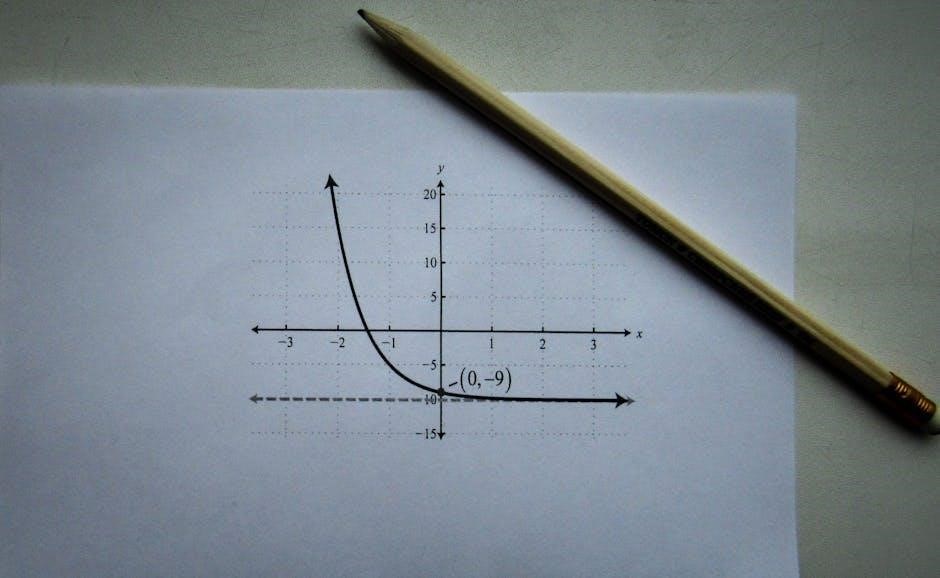
These integer operation worksheets are meticulously crafted to provide a focused and effective learning experience; A key feature is the inclusion of very short answer questions, promoting concise responses and quick assessment of understanding. The worksheets are designed with clarity in mind, presenting problems in an organized and accessible manner for students.
Typically, these resources contain a substantial number of practice problems – often around 30 – covering addition, subtraction, multiplication, and division of integers. The worksheets are specifically targeted towards 6th-grade mathematics curricula, aligning with common core standards and providing appropriate challenges for this age group. They serve as excellent tools for classroom practice, homework assignments, or supplemental learning.
Worksheet Content: Addition, Subtraction, Multiplication, and Division
The core of these worksheets revolves around mastering integer operations. Students will encounter a diverse range of problems designed to build proficiency in adding, subtracting, multiplying, and dividing both positive and negative integers. Expect to find exercises that require applying the rules for operating with integers, including understanding how to handle different signs.
Problems are often presented in varied formats, potentially including simple equations, word problems, or even problems arranged in circular patterns to enhance engagement. The content progressively builds in complexity, starting with basic operations and gradually introducing more challenging scenarios. The goal is to ensure students develop a solid conceptual understanding and procedural fluency in working with integers across all four fundamental operations.
Worksheet Format: Short Answer Questions
These integer operation worksheets primarily utilize a short answer question format. This design encourages students to demonstrate their understanding by directly calculating and recording the answers to each problem, rather than selecting from multiple-choice options. The focus is on showing the work and arriving at the correct solution independently.
Expect a clean and uncluttered layout, prioritizing clarity and ease of use. Each problem will typically be presented on a separate line or within a designated space, allowing ample room for students to write their solutions. This format is ideal for assessing procedural fluency and identifying areas where students may be struggling with specific integer operations. The brevity of the answers also facilitates quick and efficient grading.
Target Grade Level: 6th Grade Mathematics
These operations on integers worksheets are specifically tailored for 6th-grade mathematics students. This age group is typically introduced to the concept of integers – both positive and negative numbers – and begins to develop proficiency in performing basic arithmetic operations with them. The worksheets are designed to reinforce classroom learning and provide ample practice opportunities.
The complexity of the problems aligns with the 6th-grade curriculum, focusing on foundational skills. While more advanced integer concepts may be introduced in later grades, these materials concentrate on building a solid understanding of addition, subtraction, multiplication, and division involving integers. The goal is to establish a strong base for future mathematical studies, ensuring students are well-prepared for more complex topics.
Resources and Further Practice
Beyond these operations on integers worksheet PDFs, numerous online tools offer supplementary practice. Several websites provide interactive exercises and quizzes, allowing students to test their understanding and receive immediate feedback. These digital resources can be particularly helpful for reinforcing concepts learned through traditional worksheets.
Furthermore, utilizing bulletin board posters displaying integer rules and examples can create a visually stimulating learning environment. These posters serve as constant reminders of key concepts, aiding in retention. For students seeking additional support, exploring online tutorials and educational videos can provide alternative explanations and problem-solving strategies. Consistent practice, combined with diverse learning resources, is crucial for mastering integer operations.

Online Integer Practice Tools

Numerous websites complement operations on integers worksheet PDFs with interactive learning experiences. Platforms offer dynamic exercises, ranging from basic identification of positive and negative numbers to complex multi-step problems. Many provide instant scoring and personalized feedback, allowing students to pinpoint areas needing improvement.
Khan Academy, for instance, delivers comprehensive integer tutorials and practice sets aligned with various skill levels. IXL Learning also features targeted integer practice, tracking student progress and adapting difficulty accordingly. These tools often incorporate gamified elements, enhancing engagement and motivation. Utilizing these online resources alongside traditional worksheets fosters a well-rounded understanding of integer concepts, solidifying skills through diverse methods.
Where to Find Printable Integer Worksheets (PDF)
Locating high-quality, printable integer worksheets in PDF format is readily achievable through various online educational resource hubs. Websites like Math-Drills.com and K5 Learning offer extensive collections categorized by skill level and operation type – addition, subtraction, multiplication, and division. These resources frequently provide answer keys for self-assessment and teacher convenience.
Teachers Pay Teachers also hosts a wealth of user-created integer worksheets, often tailored to specific curriculum needs. A simple Google search using keywords like “integer worksheets PDF 6th grade” yields numerous results. Ensure the worksheets align with learning objectives and offer a variety of problem types to promote comprehensive understanding. Downloading PDFs allows for easy printing and offline practice, supplementing digital learning tools.
Utilizing Bulletin Board Posters for Learning
Visually reinforcing integer concepts through bulletin board posters significantly aids student comprehension and retention. These posters should clearly illustrate the rules for adding, subtracting, multiplying, and dividing integers, using color-coding and memorable examples. Displaying posters demonstrating the number line and the concept of opposites provides a foundational visual aid.
Creating posters that showcase “real-world” applications of integers – such as temperature changes, debt, or elevation – enhances relevance. Interactive posters, where students can manipulate elements or solve quick problems, promote active learning. Supplementing worksheet practice with these visual cues creates a more engaging and supportive learning environment, solidifying understanding of integer operations and fostering classroom participation.